Support our educational content for free when you purchase through links on our site. Learn more
History of Perfume Brands: 12 Houses That Changed Scent 🌸

The history of perfume brands begins long before modern labels: fragrance-making spans ancient cultures, while recognizable perfume houses emerged centuries later through craft, trade, chemistry, and clever branding. France became a major center of modern perfumery, but it didn’t invent perfume—and the stories behind today’s iconic names reach far beyond Paris.
One early recorded perfume-maker was Taputi, named on a Babylonian cuneiform tablet. Thousands of years later, brands such as Farina, Guerlain, Chanel, and Estée Lauder would help turn fragrance into a recognizable part of commerce, fashion, and everyday life. But what makes a perfume house truly historic: its age, its influence, or the scent everyone still remembers?
Key Takeaways
- Perfume predates perfume brands by thousands of years. Ancient societies used incense, oils, scented balms, and aromatic waters for ritual, grooming, and trade.
- The history of perfume is global. France became a modern perfumery powerhouse, but important fragrance traditions developed across the Middle East, South Asia, East Asia, and the ancient Mediterranean.
- Brand influence takes many forms. Farina helped shape Eau de Cologne; Guerlain built a celebrated French perfume house; Chanel connected fragrance with fashion; Estée Lauder helped make perfume part of everyday beauty.
- Chemistry transformed perfumery. Synthetic aroma materials expanded perfumers’ palettes and made new scent effects and more consistent production possible.
- A founding date needs context. A company’s origins, its current ownership, and continuous operation are not always the same thing.
- Classic perfumes can change over time. Reformulation, ingredient availability, safety standards, and bottle storage can all affect how a fragrance smells.
Table of Contents
- ⚡️ Quick Tips and Facts
- 🌿 Perfume Before Perfume Brands: Ancient Fragrance History
- Incense, oils, and early perfume-making traditions
- Egypt, Mesopotamia, Greece, and Rome
- 🧭 How Perfume Traveled Across Cultures and Trade Routes
- The influence of the Islamic Golden Age
- Spices, ingredients, and the Silk Road
- 🇫🇷 France and the Rise of Modern Perfumery
- Grasse, gloves, and the perfume trade
- The first perfume houses and branded fragrances
- 🧪 From Natural Ingredients to Modern Perfume Chemistry
- The invention of synthetic aroma materials
- How chemistry changed fragrance creation
- 🏛️ 12 Pionering Perfume Brands That Shaped Fragrance History
- 1. Farina and the story of Eau de Cologne
- 2. Guerlain and French heritage perfumery
- 3. Coty and the modern perfume business
- 4. Chanel and the rise of designer perfume
- 5. Dior and postwar fragrance glamour
- 6. Estée Lauder and American beauty culture
- 7. Lancôme and French luxury fragrance
- 8. Hermès and the art of understated scent
- 9. Yves Saint Laurent and fashion-led perfumery
- 10. Shiseido and Japanese fragrance design
- 11. Calvin Klein and minimalist perfume marketing
- 12. Jo Malone London and modern fragrance layering
- 🗓️ Perfume Brand History by Era
- The 18th and 19th centuries: perfume houses take root
- The early 20th century: couture, advertising, and iconic scents
- The postwar decades: designer fragrances go mainstream
- The 1980s and 1990s: bold scents and global brands
- The 21st century: niche perfumery and digital discovery
- 🌸 How Iconic Perfume Styles and Fragrance Families Evolved
- Chypre, fougère, floral, and amber traditions
- From aldehydic classics to gourmand perfumes
- 🧴 How Perfume Bottles, Packaging, and Branding Became Icons
- 📣 Advertising, Celebrity Endorsements, and Perfume Culture
- 🌍 Perfume Brands Around the World
- French, Italian, British, and American fragrance houses
- Middle Eastern, Indian, and East Asian perfume traditions
- ♻️ Ownership, Reformulation, Sustainability, and Ethical Sourcing
- 🔎 How to Research a Perfume Brand’s History
- ❓ Frequently Asked Questions About Perfume Brand History
- What was the first perfume brand?
- Which perfume house is the oldest still operating?
- When did designer perfumes become popular?
- Why do classic perfumes smell different today?
- What is the difference between a perfume house and a fragrance brand?
- ✅ Conclusion
- 🔗 Recommended Links
- ❔ FAQ
- 📚 Reference Links
Quick Tips and Facts
- Perfume history is older than perfume brands. People used fragrant resins, woods, flowers, and oils for ritual, personal adornment, medicine, and trade long before recognizable commercial houses existed. For a quick explanation of the terminology, see our guide to what perfume brands are called.
- The word perfume comes from the Latin per fum, commonly translated as “through smoke,” a nod to aromatic materials burned as incense. Encyclopaedia Britannica describes perfume as a blend of fragrant materials used to provide a pleasing scent.
- Perfume did not begin in France. Ancient Egypt, Mesopotamia, the Indus Valley, Greece, Rome, Persia, and other cultures all developed distinct fragrance practices. France later became a major center of the modern perfume trade.
- A perfume recipe, a perfume house, and a perfume brand are not the same thing. A recipe is a formula; a house is a company or creative institution; and a brand is the identity under which a fragrance is presented and sold.
- One of the earliest named perfume-makers is Taputi, recorded on a Babylonian cuneiform tablet. The exact date and interpretation of the tablet are debated, so treat “first perfumer” as a useful shorthand, not a perfectly settled title. The British Museum’s guide to cuneiform explains the writing system behind such records.
- A large Bronze Age perfume-production site was excavated on Cyprus, showing that fragrance could be made on a substantial scale thousands of years ago. The site is widely discussed in archaeological accounts, including this overview of the Pyrgos perfume factory.
- Modern brand history takes shape much later, as makers build recognizable names, bottle designs, retail networks, and repeatable formulas. Among the important surviving houses are Guerlain, Santa Maria Novella, and Roger & Gallet.
- Chemistry changed perfumery. Synthetic aroma materials expanded the perfumer’s palette and helped create scents that were harder to make, source, or standardize using natural materials alone. The International Fragrance Association provides information on fragrance materials and safety standards.
- Not every famous perfume was originally a perfume. Estée Lauder’s Youth-Dew began as a bath oil, a clever shift that helped make fragrance feel suitable for everyday use. The brand recounts the product’s history on its Youth-Dew page.
- Our perfumer’s takeaway: when you trace a brand’s history, look for more than its founding date. Ask who made the fragrance, what materials and techniques were available, how the bottle and marketing changed, and which claims can be independently verified. 🕵️
🌿 Perfume Before Perfume Brands: Ancient Fragrance History

Before logos, boutiques, and limited-edition bottle drops, fragrance was made in homes, temples, workshops, and royal courts. It could signal devotion, hospitality, status, or simply the pleasure of a fragrant room.
The surviving record is uneven. Archaeologists can identify vessels and production sites, while written sources preserve recipes and names, but neither tells us exactly how every ancient fragrance smelled. That gap is part of the fascination: perfume history is a mix of physical evidence, texts, and careful interpretation.
Incense, oils, and early perfume-making traditions
Early fragrance came in forms that would look familiar in spirit but not necessarily in a modern vanity cabinet:
- Incense and fumigation: aromatic woods, resins, and herbs were burned so their scent traveled with smoke.
- Scented oils: flowers, herbs, or spices were steeped or processed in oils for skin and hair.
- Balms and ointments: fragrant ingredients were incorporated into thick preparations.
- Scented waters: these became more significant as distillation methods developed.
- Perfumed objects and spaces: bedding, clothing, rooms, and ceremonial settings could all be scented.
The distinction matters. Modern shoppers often use “perfume” to mean alcohol-based fine fragrance, but historically, scented oil or incense could be the primary form. The Metropolitan Museum of Art’s materials on ancient Egyptian cosmetics offer useful context on grooming and scented preparations.
Taputi and the earliest recorded perfumer
A cuneiform tablet from ancient Mesopotamia names Taputi, a palace overser and perfume-maker. The tablet is often cited as an early record of systematic fragrance preparation. Popular retellings sometimes confidently label her “the world’s first chemist,” but the surviving evidence is a short textual record, not a full biography or laboratory notebook. It is safest to call her one of the earliest named practitioners known from written sources.
That caution is a perfumer’s habit: a compelling story is welcome, but the evidence should set the strength of the claim.
A Bronze Age perfume workshop on Cyprus
Excavations at Pyrgos-Mavroraki on Cyprus revealed a large production complex dating to the Bronze Age, often described as roughly 4,000 years old. Archaeologists found evidence associated with perfume production, including equipment and residues. The scale suggests that fragrant goods could be made for more than one household or ceremony.
What we can infer: organized production existed.
What we cannot confidently infer: that the site operated exactly like a modern perfume factory, or that every reconstructed recipe is certain.
Egypt, Mesopotamia, Greece, and Rome
Ancient fragrance practices varied by place and purpose. Egyptians used aromatic materials in ritual and grooming; Greek and Roman writers described perfumes made with flowers, herbs, woods, spices, and resins. The Getty’s overview of ancient perfume explores how scent was woven into ancient life.
| Culture or region | Fragrance forms and materials | Common contexts | What the evidence tells us |
|---|---|---|---|
| Ancient Egypt | Aromatic oils, resins, incense, scented balms | Ritual, grooming, burial practices | Tombs, objects, texts, and residue studies contribute evidence |
| Mesopotamia | Incense, oils, recorded recipes | Palace and temple settings | Cuneiform records include named practitioners and preparations |
| Ancient Greece | Scented oils, floral and herbal materials | Grooming, athletic life, religious use | Literary sources describe ingredients and applications |
| Ancient Rome | Perfumed oils, powders, incense, scented spaces | Personal adornment, public life, trade | Roman writers discuss both the appeal and expense of fragrance |
| Bronze Age Cyprus | Large-scale production evidence | Likely organized manufacture and trade | Archaeological remains point to production beyond household use |
Greek and Roman perfumes were generally not the alcohol-based sprays we associate with modern fine fragrance. Oils were important carriers, and formulations could be applied to the body, hair, objects, and interiors. Roman author Pliny the Elder famously criticized perfume as excessive luxury, which tells us something useful: fragrance was already a consumer good with social meaning—and a lively debate around it.
A video summary presented with this article offers another accessible sweep through ancient perfume, from Egyptian ritual to modern synthetics. Its account is helpful as an overview, while archaeological and museum sources are better for checking specific claims such as the exact identity of the “oldest factory” or the details of individual ancient formulas.
🧭 How Perfume Traveled Across Cultures and Trade Routes
Perfume history is also a history of movement. Ingredients traveled; techniques traveled; so did the desire for fragrant materials. A rose, resin, spice, or aromatic wood could pass through many hands before reaching a workshop.
Scent is unusually dependent on geography. Some flowers must be processed near where they grow; others can be dried, distilled, pressed, or traded over long distances. This is one reason the history of perfume brands cannot be separated from agriculture, trade, and technology.
The influence of the Islamic Golden Age
Scholars and craftspeople across Persian and wider Islamic societies helped develop practical knowledge of distillation, equipment, and fragrant materials. Al-Kindi’s writings on perfumes and distillations are frequently cited as an early technical contribution; Ibn Sina (Avicena) is associated with advances in distilling floral waters, particularly rosewater.
The history deserves care: knowledge did not move in a single direction, and no one civilization “invented perfume” by itself. Techniques evolved across connected communities, with knowledge adapted and expanded through scholarship, craft, and commerce. For context on the scientific history of distillation, see the Science History Institute’s resources on chemistry.
| Contribution | Why it mattered to fragrance |
|---|---|
| Improved distillation methods | Made fragrant waters and oils more practical to produce |
| Written recipes and technical notes | Helped preserve and transmit methods |
| Trade in roses, musk, spices, resins, and woods | Broadened the materials available to perfumers |
| Specialized glass and metal equipment | Supported more controlled processing |
Rosewater became an especially important product across regions. It could scent the body and spaces, flavor food, and serve ceremonial purposes. The same material might be understood through several lenses at once: luxury, hospitality, personal care, and craft.
Spices, ingredients, and the Silk Road
Trade routes carried aromatic materials alongside textiles, medicines, dyes, and food. Ingredients that became prized in perfumery included frankincense, myrrh, cinnamon, saffron, musk, ambergris, rose, and precious woods. Their availability depended on cultivation, harvesting, trade relationships, and the ability to preserve them.
How to read historical ingredient claims
When a source says ancient perfume “contained” a particular ingredient, ask what kind of evidence supports that statement:
- Written recipe: useful, but names and translations can be uncertain.
- Archaeological residue: can identify chemical traces, though mixtures may be difficult to reconstruct.
- Trade records: show that a material was available, not necessarily used in one specific perfume.
- Later retelling: can preserve a tradition but may add details unsupported by primary evidence.
That distinction keeps a fascinating scent story from becoming a confidently repeated myth. It also explains why modern reconstructions of ancient perfumes may differ: researchers have different evidence, methods, and interpretive choices.
🇫🇷 France and the Rise of Modern Perfumery
France became a major center of perfumery through a combination of craft, cultivation, commerce, court culture, and fashion—not because fragrance began there. Italian expertise, Mediterranean trade, local flower production, and changing European tastes all contributed.
The story often begins with the French court, but the more durable transformation was structural: specialist producers, guilds, recognizable houses, improved manufacturing, and retail networks gradually made fragrance a more organized industry.
Grasse, gloves, and the perfume trade
The town of Grasse in southern France became closely associated with flowers and fragrance production. Its history includes leatherworking and the use of scented gloves, followed by a growing role in cultivating and processing fragrant plants. The UNESCO listing for the perfume-related skills of Grasse recognizes the region’s knowledge of cultivation, raw-material processing, and composition.
The town’s reputation grew through a chain of specialized work:
- Grow fragrant plants such as jasmine, rose, and tuberose.
- Harvest them at the right time, often when their scent profile is most desirable.
- Process the blossoms or other raw materials to capture aromatic components.
- Supply those materials to perfumers and fragrance houses.
- Develop a local identity that links place, craft, and scent.
This is one reason “made in Grasse” carries more than a postcard’s worth of charm: it evokes a regional ecosystem of cultivation and expertise. But it does not automatically tell you that a finished perfume was entirely made there or that every ingredient came from the region.
The first perfume houses and branded fragrances
The transition from a perfumer’s workshop to a recognizable perfume house was gradual. Companies increasingly built reputations around a name, a style, a product range, and a relationship with customers.
What makes a perfume house a “brand”?
A house becomes recognizable when it combines some or all of these elements:
- A stable name attached to fragrance products.
- Repeatable production and recognizable quality.
- A distinct creative identity, whether based on a founder, location, or aesthetic.
- Retail presence and a way for customers to find the products.
- Packaging and communication that make one maker distinguishable from another.
This is why claims about “the first perfume brand” can be slippery. Some old makers have long histories, but their ownership, product lines, and corporate structures may have changed over time. Santa Maria Novella traces its history to Florence, while Guerlain tells the story of its French perfume house. Those histories are valuable brand sources, but a company’s own heritage page should be read alongside independent historical records.
| House or maker | Historical significance | Helpful note |
|---|---|---|
| Santa Maria Novella | Connects a longstanding Florentine tradition with contemporary retail | Institutional continuity and modern corporate structure are different questions |
| Guerlain | A major French perfume house with a documented heritage | Its history reflects both fragrance craft and luxury branding |
| Roger & Gallet | Associated with the commercial history of cologne and scented personal care | Brand histories can span changing owners and product eras |
| Farina | Closely linked with the history and naming of Eau de Cologne | “First” claims about cologne depend on how the term is defined |
🧪 From Natural Ingredients to Modern Perfume Chemistry
For centuries, perfumers worked with materials from plants, animals, and minerals. Modern perfumery expanded dramatically when chemistry made it possible to isolate, reproduce, and create aroma materials with greater consistency.
This did not simply replace nature. Natural materials remained important, while laboratory-made ingredients offered new effects, reliable supply, and creative options. The modern perfumer’s palette is a conversation between both.
The invention of synthetic aroma materials
The phrase “synthetic perfume” can sound as if a fragrance is entirely artificial. In practice, a finished fragrance may combine natural extracts, isolated molecules, and synthetic aroma materials in many proportions. Some synthetics reproduce or approximate aspects of natural materials; others provide effects that do not occur in the same way in nature.
The International Fragrance Association’s ingredient information and the Royal Society of Chemistry are useful places to learn more about chemical materials and their role in fragrance.
What changed for perfumers?
- Consistency: a material could be more reliably available than a crop affected by weather or harvest variation.
- New scent effects: chemistry opened doors to airy, abstract, and long-lasting impressions.
- Formulation flexibility: perfumers could build accords with different balances of natural and manufactured materials.
- Supply and scale: ingredients could sometimes be produced more predictably for larger markets.
- New questions: safety, regulation, transparency, and environmental impact became increasingly important.
A historical scent that once relied on a difficult-to-source natural material might be reformulated with substitutes or a different balance. That doesn’t automatically mean the new version is careless or inferior. It may reflect regulatory restrictions, sourcing realities, cost structure, or a change in creative direction.
How chemistry changed fragrance creation
A useful way to picture modern fragrance is as a musical score. Natural materials can behave like a full orchestra, with many aromatic facets; isolated and synthetic materials can act like precise notes, bright accents, or entirely new instruments. A skilled perfumer uses each according to the composition.
Perfumers’ practical advice: when you read that a scent contains “rose,” “musk,” or “amber,” don’t assume the label reveals a literal ingredient list. Fragrance descriptions often communicate an impression or accord, not a complete formula. The actual composition is usually proprietary.
For more on scent styles and wear, browse our Fragrance Reviews and Classic Scents.
🏛️ 12 Pionering Perfume Brands That Shaped Fragrance History

No short list can capture every important perfume house. These 12 selections highlight different kinds of influence: longevity, fragrance innovation, fashion partnerships, global reach, or a shift in how perfume was marketed.
A word about “oldest”: a brand’s founding date may refer to a shop, a family business, a later corporate entity, or a particular product line. Always check what the date actually describes.
1. Farina and the story of Eau de Cologne
Johann Maria Farina is central to the history of Eau de Cologne. Farina’s house traces its origins to the early 18th century in Cologne and describes its signature fragrance as a fresh blend of citrus and aromatic materials. The company’s own history page is the best place to explore its account.
Eau de Cologne became a style as well as a product category. Its lighter, citrus-led character offered a different experience from heavier oils and concentrated compositions. Napoleon is often associated with consuming large quantities of cologne, but individual historical anecdotes can be difficult to verify in every detail.
Why Farina matters: the house helped attach a recognizable maker’s name to a fragrance style that later became widely imitated.
2. Guerlain and French heritage perfumery
Founded in Paris in 1828, Guerlain became one of France’s best-known fragrance houses. Its history stretches across several generations and includes scents that became touchstones for different eras.
Guerlain’s influence is not only a matter of age. The house developed a strong identity through signature compositions, bottle design, retail presentation, and a continuing dialogue between tradition and modernity. Its history is also a reminder that “heritage” is maintained through reinvention, not just preserved behind glass.
Benefit: a rich archive of style and craftsmanship.
Caveat: a long-lived house’s current products may differ from historic formulas, ownership structures, original production methods.
3. Coty and the modern perfume business
François Coty helped change how perfume was sold and presented in the early 20th century. His business combined fragrances with striking bottles, broad distribution, and a marketing approach that helped make perfume more visible to a wider audience.
Coty’s history reflects a major industry shift: a perfume could be both a crafted scent and a mass-market product with recognizable branding. The company’s modern corporate identity is not identical to the original business, so it helps to distinguish the founder’s era from today’s organization. See Coty’s corporate history for the company’s account.
4. Chanel and the rise of designer perfume
Chanel No. 5 became one of the most influential fragrances of the 20th century. Launched in 1921, it is closely associated with Gabrielle “Coco” Chanel and perfumer Ernest Beaux. Chanel’s official No. 5 history explains the house’s account of its creation.
Its significance reaches beyond the formula. No. 5 helped establish the idea that a fashion house could create an enduring fragrance identity, supported by bottle design, advertising, and cultural visibility.
Why it still matters: it made perfume part of the fashion brand’s world, rather than merely an accessory sold by a specialist perfumer.
5. Dior and postwar fragrance glamour
Christian Dior’s first fragrance, Miss Dior, appeared in 1947, the same year the fashion house introduced its postwar collection. The brand presents the fragrance as connected to Dior’s vision of style and femininity; see Dior’s fragrance heritage.
The pairing of couture and fragrance gave perfume a powerful narrative: a scent could express the spirit of a fashion collection and carry that identity beyond the runway. Dior’s later fragrance portfolio expanded into several different styles, from florals to bold, modern compositions.
6. Estée Lauder and American beauty culture
Estée Lauder helped build an American beauty company with fragrance at its heart. Youth-Dew, introduced in the early 1950s as a bath oil, made scent feel less like a rare gift and more like something a woman could choose for herself as part of everyday care.
That change in format was clever. A bath oil could be purchased as a beauty product, then enjoyed for its fragrance. The strategy helped shift perfume from “save it for a special occasion” toward regular use. The brand’s product story is available on its Youth-Dew page.
7. Lancôme and French luxury fragrance
Founded in France in 1935, Lancôme built a broad beauty identity that includes fragrances, skincare, and cosmetics. Its history illustrates how perfume became part of a complete luxury and beauty experience rather than a standalone product category.
From classic floral styles to contemporary launches, Lancôme has helped connect French heritage language with global retail. As with other houses, its history should be read across multiple product eras rather than reduced to a single signature scent.
8. Hermès and the art of understated scent
Hermès began as a Parisian harness workshop in 1837 and later expanded into fashion and fragrance. The house’s fragrance identity is often associated with material craft, clear storytelling, and a relatively restrained luxury aesthetic. See the brand’s fragrance collection.
A fragrance such as Tere d’Hermès shows how a house can create a scent world that feels connected to its broader design philosophy without simply turning a handbag or scarf into a bottle. Explore more options in our Men’s Perfumes category.
9. Yves Saint Laurent and fashion-led perfumery
Yves Saint Laurent Beauté brought a fashion-house sensibility to a wide range of fragrances. Opium, launched in 197, became known for its dramatic name, presentation, and rich profile; later releases broadened the brand’s fragrance identity.
YSL’s history demonstrates how perfume branding can challenge polite expectations. A name, campaign, and bottle can provoke as much conversation as the scent itself. That is powerful marketing—but fragrance lovers should still judge the juice on their own skin.
10. Shiseido and Japanese fragrance design
Founded in 1872 as a pharmacy in Tokyo, Shiseido grew into a global beauty company. Its history offers a different perspective from the familiar French-and-Italian-centered story: Japanese beauty companies also shaped international fragrance and cosmetics culture.
Shiseido’s fragrance work includes collaborations with respected perfumers and distinctive design sensibilities. Its heritage also highlights how fragrance history is global, even when Western luxury houses dominate many popular timelines.
11. Calvin Klein and minimalist perfume marketing
Calvin Klein helped make fragrance marketing feel modern, youthful, and pared back. CK One, introduced in the 1990s, became a landmark in the marketing of unisex fragrance, using clean design and a broadly inclusive campaign. The brand’s official fragrance collection provides its current range.
CK One did not invent shared-gender fragrance. Its influence lies in bringing that idea into mainstream advertising on a large scale and making it a defining part of its public identity.
12. Jo Malone London and modern fragrance layering
Jo Malone London is known for a clean, giftable visual style and fragrance layering as part of its brand story. Founded by Jo Malone in London, the company helped popularize the idea that customers could combine scents to personalize their fragrance experience.
A practical note from our team: layering can be fun, but start with two fragrances that share a note or contrast gently. Try them on a bloter before your skin, then give the combination time to settle. More isn’t always more; sometimes one well-chosen scent is the better conversation.
🗓️ Perfume Brand History by Era

A timeline helps us see why perfume brands changed: not just because tastes shifted, but because production, fashion, advertising, transport, and household buying habits changed too.
| Era | What changed | Brand-history significance |
|---|---|---|
| Ancient world | Fragrance served ritual, personal, and social roles | Craft and trade existed before modern consumer brands |
| Medieval and early modern periods | Distillation, trade, and specialized makers developed | Fragrance knowledge moved across regions and workshops |
| 18th–19th centuries | Perfume houses and commercial cologne became more recognizable | Makers increasingly built lasting names |
| Early 20th century | Fashion, glassmaking, advertising, and chemistry converged | Designer fragrance became a powerful category |
| Postwar decades | Beauty products reached wider consumer markets | Fragrance became more routine and self-purchased |
| Late 20th century onward | Global marketing and niche houses expanded | Consumers encountered more styles and identities |
The 18th and 19th centuries: perfume houses take root
This period saw recognizable fragrance businesses grow alongside advances in manufacturing, retail, and packaging. Houses such as Farina and Guerlain became associated with distinct products and a continuing commercial identity.
France rose influence, but it was not alone. Italian, German, British, Russian, and other fragrance businesses also shaped the trade. The Perfume Society’s history overview gives a helpful era-by-era introduction, while brand archives can clarify a company’s own dates and milestones.
The early 20th century: couture, advertising, and iconic scents
By the early 20th century, perfume was closely tied to fashion, design, and modern advertising. Chanel No. 5 and Coty’s commercial strategies illustrate two complementary developments:
- A fashion house could create a signature scent that expressed its identity.
- A fragrance company could make packaging, promotion, and distribution central to a product’s success.
The bottle mattered. The name mattered. The campaign mattered. And, thankfully, so did the fragrance—because a beautiful advertisement cannot rescue a scent you do not enjoy.
The postwar decades: designer fragrances go mainstream
After World War II, economic and cultural changes helped bring fragrance to more households. Youth-Dew is a notable example of a product that made scent easier to buy and wear regularly by presenting it as a bath product.
The broader shift was from perfume as an occasional luxury toward perfume as part of personal style and beauty routines. This wasn’t a universal change everywhere at once: access and customs varied by country, income, and generation.
The 1980s and 1990s: bold scents and global brands
The later 20th century brought powerful advertising, global distribution, celebrity culture, and fragrance launches designed to be instantly recognizable. The era also saw the rise of fresher, more casual, and unisex positioning, exemplified by the marketing of CK One.
These decades are often remembered for big, expressive scents, but that’s only part of the story. Light colognes, minimalist fragrances, and niche creations also developed alongside the louder bestsellers.
The 21st century: niche perfumery and digital discovery
The internet changed how perfume brands reach customers. Reviews, online sample services, social platforms, and direct-to-consumer websites made it easier to discover small houses and compare opinions before buying.
Today’s landscape includes:
- Heritage houses emphasizing long histories and archives.
- Designer brands connecting fragrance to fashion and celebrity.
- Niche brands focused on a distinctive creative point of view.
- Indie perfumers building smaller, direct relationships with customers.
- Beauty conglomerates managing portfolios across many fragrance identities.
For current industry coverage, visit our Fragrance Industry News page. For a practical shopper’s view, browse Fragrance Reviews.
🌸 How Iconic Perfume Styles and Fragrance Families Evolved
Fragrance families are a helpful map, not a set of laws. They let us discuss styles—floral, woody, citrus, amber, chypre, fougère—without pretending that every perfume fits neatly into one box.
A perfume can begin with a bright citrus impression, move into a floral heart, and dry down with woods and musk. This structure is often described using top, middle, and base notes, though real formulas evolve continuously rather than changing in tidy stages.
Chypre, fougère, floral, and amber traditions
Some classic perfume categories developed alongside changing ingredients and tastes:
| Family or style | Typical impression | Historical note |
|---|---|---|
| Citrus and cologne | Bright, sparkling, refreshing | Closely associated with Eau de Cologne traditions |
| Floral | Petal-like, powdery, green, or creamy | Rose, jasmine, violet, and other florals have long histories |
| Chypre | Structured contrast of citrus, floral, and mossy or woody effects | The family name is associated with François Coty’s 1917 fragrance Chypre |
| Fougère | Aromatic, herbaceous, often barbershop-like | A foundational style in many men’s fragrances |
| Amber | Warm, resinous, sweet, or balsamic | “Amber” is often a style accord, not a literal amber ingredient |
| Gourmand | Food-inspired sweetness such as vanilla, chocolate, or caramel | Became especially prominent in late-20th-century fragrance culture |
The family labels are conventions, not scientific categories. The Fragrance Foundation’s fragrance-family resources can help new fragrance fans build vocabulary, while smelling perfumes on skin teaches you more than memorizing a chart.
From aldehydic classics to gourmand perfumes
Aldehydes are aroma materials that can create sparkling, waxy, soapy, citrus-like, or abstract effects depending on their use. They are often discussed in connection with Chanel No. 5, but they are not a single smell and do not automatically make a perfume “old-fashioned.”
Later fragrance trends explored aquatic freshness, clean musks, sweet gourmands, and more transparent compositions. Each trend reflects changing ideas about what feels modern, desirable, intimate, or appropriate for daily wear.
Try this at home:
- Choose one classic floral and one modern floral.
- Spray each on a separate bloter.
- Smell them immediately, then again after 20–30 minutes.
- Note what changes: brightness, sweetness, powderiness, woods, or musk.
- Repeat on skin if you enjoy them; skin warmth can alter how a fragrance develops.
That small experiment gives you a better sense of style evolution than any claim that one era’s perfumes were universally “better.”
🧴 How Perfume Bottles, Packaging, and Branding Became Icons
A perfume bottle is a container, but it is also a brand’s handshake. Before you smell anything, the bottle communicates a mood: minimal, glamorous, playful, architectural, or old-world.
Glassmaking and packaging helped perfume houses stand apart in crowded markets. Coty, Chanel, and Dior all demonstrate how bottle design and fragrance identity can reinforce each other. The Corning Museum of Glass offers broader context on glass history and design.
What a bottle can tell you—and what it cannot
It can tell you:
- How the brand wants the fragrance to be perceived.
- Whether the product is designed for display, travel, or frequent use.
- How a house distinguishes one collection from another.
It cannot reliably tell you:
- Whether the fragrance will suit your taste.
- Whether the formula is better because the packaging is heavier or more ornate.
- Whether a bottle is historically original without reliable provenance.
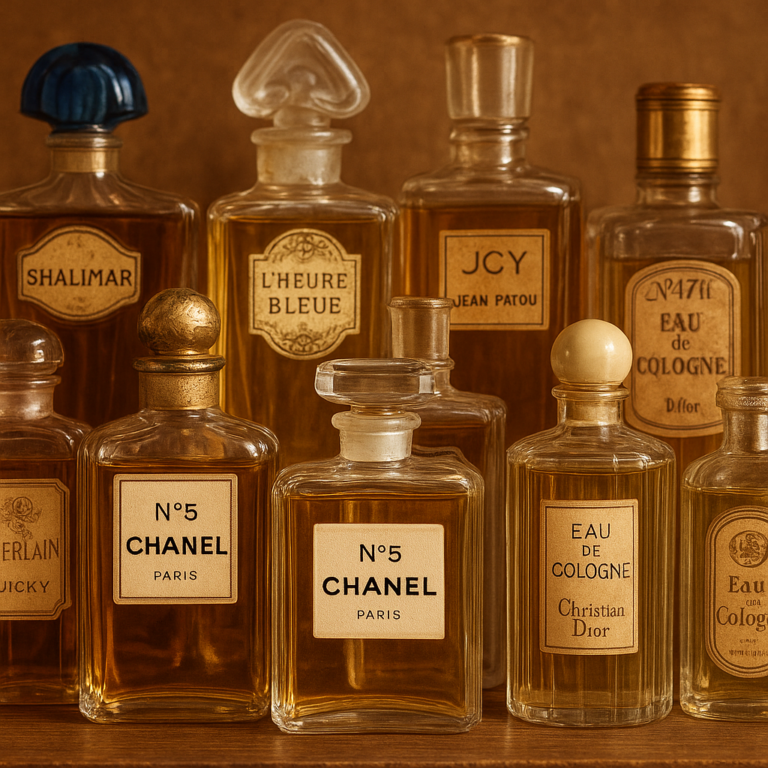
Vintage packaging can be fascinating, but collectors should check authenticity, storage, and the condition of the juice. Fragrance changes with age, light, heat, and exposure to air. Keep bottles cool and away from direct sunlight, and avoid assuming that a vintage bottle will smell exactly as it did when first released.
📣 Advertising, Celebrity Endorsements, and Perfume Culture
Perfume is difficult to describe in an advertisement. A picture cannot reproduce scent, so brands sell an atmosphere: a landscape, a personality, a fantasy, or a moment of self-expression.
That makes fragrance advertising unusually symbolic. A campaign may show a glamorous evening, a sunlit garden, a quiet minimalist bathroom, or a celebrity whose public image becomes part of the perfume’s identity.
Why perfume marketing works differently
- The product is sensory: you must smell it to judge it.
- The story can be emotional: memories and associations shape how a fragrance feels.
- The brand identity may outlast a formula: campaigns, names, and bottles can become cultural shorthand.
- Celebrity visibility creates reach: but does not prove a scent is a match for you.
- Reviews help, but skin testing matters: the same fragrance can be experienced differently from person to person.
Our perfumer’s advice is simple: enjoy the campaign, then test the fragrance. If a scent is being sold as “effortless,” “intoxicating,” or “the ultimate signature,” those are invitations to try it—not guarantees. See our Fragrance Reviews for more practical scent perspectives.
🌍 Perfume Brands Around the World
Perfume history is often told as a French story, but that leaves out important traditions and industries. Fragrance practices grew across Africa, Asia, Europe, the Middle East, and the Americas, with local materials and techniques shaping distinct scent cultures.
A truly global account makes room for attar, incense, floral waters, cologne, aromatic oils, and modern fine fragrance. It also recognizes that one region’s “perfumery” may not follow the same format or retail history as another’s.
French, Italian, British, and American fragrance houses
- France: Grasse and Paris became important centers for cultivation, composition, fashion, and luxury branding.
- Italy: Florence and other cities developed traditions in scented waters and apothecary products; Santa Maria Novella connects contemporary retail with a historic Florentine story.
- Germany: Cologne’s name became attached to Eau de Cologne, with Farina central to its commercial history.
- Britain: British fragrance culture includes both heritage makers and contemporary brands such as Jo Malone London.
- United States: Companies such as Estée Lauder helped reshape how perfume was marketed and used in everyday beauty routines.
These labels are starting points, not complete descriptions. A brand may be founded in one country, owned in another, manufactured across multiple locations, and sold globally.
Middle Eastern, Indian, and East Asian perfume traditions
Fragrance traditions in the Middle East and South Asia include the use of oud, rose, musk, incense, attar, and concentrated oils. These forms do not always align neatly with Western eau de parfum categories, and they deserve to be understood on their own terms.
India’s aromatic traditions include attars and ingredients such as rose, vetiver, and sandalwood. Across East Asia, fragrance customs have included incense, aromatic woods, and later modern perfume businesses. Shiseido’s company history provides one useful view of Japan’s role in the global beauty industry.
A respectful shopper’s note: a material or practice can carry cultural, spiritual, or regional meaning. Treat unfamiliar fragrance traditions as more than a trend, and seek sources from people and institutions connected to those traditions.
♻️ Ownership, Reformulation, Sustainability, and Ethical Sourcing
A famous perfume house may change owners, formulas, suppliers, or production locations over time. That is normal in a global industry, but it can make “heritage” harder to interpret.
Why a classic fragrance may smell different today
A formula may change because:
- An ingredient is restricted or removed under safety rules.
- A natural material becomes difficult to source consistently.
- A company updates production or quality standards.
- Ownership or creative direction changes.
- The fragrance is adapted for new markets or product formats.
- A vintage bottle has aged, been stored poorly, or lost volatile notes.
The IFRA Standards describe restrictions and guidance for fragrance ingredients. Rules and standards can affect particular materials, but a changed smell alone does not prove why a formula changed. Brands may not publish full formulas, and reformulation histories are not always transparent.
Sustainability questions worth asking
- Are raw materials sourced responsibly and traceably?
- Does the brand explain its packaging choices?
- Does it provide information about refill or recycling programs?
- Are claims specific and verifiable, or mostly atmospheric?
- How are workers and growing communities treated?
There is no single sustainability label that answers every question. Look for detailed reporting, clear sourcing policies, and independent certification where relevant. For company-specific claims, consult the brand’s own sustainability reports and compare them with external standards.
🔎 How to Research a Perfume Brand’s History

Want to know whether a perfume house is truly “the oldest,” whether a classic formula changed, or who created a landmark fragrance? Use a small source-checking routine before repeating the claim.
A step-by-step research method
-
Start with the brand’s official history page.
It is useful for dates, names, and how the company understands its own heritage. Remember that it is also a brand narrative. -
Find an independent source.
Look for museum collections, university publications, national heritage organizations, newspapers of record, or scholarly books. -
Check what a founding date means.
Does it mark a shop, a company registration, a first product, or the beginning of a later corporate structure? -
Separate fact from legend.
Claims about secret passages, royal preferences, and unforgettable scents are memorable—but may come from later retellings. -
Compare the wording.
“Founded in,” “began as,” “first documented,” and “still operating” are not interchangeable. -
For formula history, look for specific evidence.
Brands may confirm a reformulation, but exact formulas are usually proprietary. Retail descriptions and collector anecdotes should not be treated as definitive proof. -
Note disagreement rather than hiding it.
If sources differ, explain whether they are using different definitions or relying on different evidence.
How weigh conflicting perfume-history sources
Brand heritage pages are strongest for the company’s own chronology and current product information. Museum and academic sources are generally stronger for archaeological context and material culture. Trade organizations are useful for industry standards, while encyclopedias and general histories provide an accessible starting point.
For example, one source may call a company the “oldest perfume house,” while another identifies an earlier maker. They may be counting different things: continuous operation, earliest written record, or current corporate identity. The most trustworthy answer is often a clearly defined answer, not a dramatic superlative.
❓ Frequently Asked Questions About Perfume Brand History

What was the first perfume brand?
There is no universally agreed first modern perfume brand. Ancient perfumers made and traded fragrant products long before the modern idea of a consumer brand existed. If “brand” means a named maker with an enduring commercial identity, the answer depends on whether you count the earliest recorded business, continuous operation, or a recognizable product line.
Farina is central to the history of Eau de Cologne, while Santa Maria Novella and Guerlain represent longstanding European houses. Their claims should be compared using the same definition rather than treated as directly interchangeable.
Which perfume house is the oldest still operating?
The answer depends on what “still operating” means. Some houses trace their origins to a historic shop or institution, while their current ownership and corporate structure may be much newer.
Our careful answer: name the house, the date it claims, and what that date refers to. Santa Maria Novella traces its story to Florence in 1221, while Guerlain dates its Parisian house to 1828. Those are different kinds of historical claims and should not be reduced to a simple race for “oldest.”
How did French perfume brands become famous?
France’s reputation grew through a combination of regional flower cultivation, skilled production, trade, court culture, specialist retailers, and connections to fashion. Grasse developed a strong role in perfume-plant cultivation and processing, while Paris became a major center for luxury houses and design.
French influence was substantial, but it built on knowledge and trade from many regions. The UNESCO description of Grasse’s perfume-related skills helps explain the craft behind the region’s reputation.
Which perfume brands have the most influential histories?
Influence depends on what you value. Guerlain represents a long-running French house; Coty helped shape modern commercialization and packaging; Chanel connected fashion with a lasting signature scent; Estée Lauder helped normalize everyday fragrance through Youth-Dew; and Calvin Klein brought unisex perfume marketing into mainstream view.
For a fuller global picture, include Farina, Shiseido, Santa Maria Novella, Dior, Hermès, Yves Saint Laurent, and Jo Malone London. There is no objective “most influential” ranking; each affected a different part of the industry.
How have perfume brands changed over the centuries?
Perfume moved from local craft and ritual use toward specialized houses, global consumer brands, and a diverse mix of designer, niche, and indie makers. Production shifted from oils, incense, and scented waters to formulas combining natural extracts and modern aroma materials. Branding, bottle design, advertising, and digital reviews now influence discovery as much as the fragrance family itself.
The key change is not that modern perfume replaced old traditions. It is that more forms of perfumery now coexist, from traditional attars and incense to contemporary fine fragrance.
Why do classic perfumes sometimes smell different today?
Possible reasons include reformulation, ingredient restrictions, changes in sourcing, different production methods, or the aging and storage of an old bottle. A reformulation may also be subtle, and personal memory can make a new bottle seem different from the version you remember.
To check a specific claim, look for a clear statement from the brand and compare reliable historical sources. Avoid assuming that every difference is caused by regulation or that every vintage bottle represents the original formula perfectly.
Did perfume begin in France?
No. Fragrance-making traditions developed across many ancient cultures, including Egypt, Mesopotamia, Greece, Rome, Persia, and the Indus Valley. France became a leading center of modern European perfumery, but perfume itself has a much broader and older history.
Why are some fragrances called “Eau de Cologne”?
The term is associated with Cologne, Germany, and a style of light, fresh fragrance linked to Farina. Over time, “cologne” also became a broader label for lighter fragrance concentrations, particularly in some markets. The word can therefore describe either a historical style or a modern product concentration, depending on context. For a look at how fragrance categories are named, visit our men’s perfume guide.